美国贸易代表办公室于2月21日公布了对中国海事、物流和造船301调查拟议措施,拟对中国建造的船舶及相关海运经营人征收额外港口费用并施加货运限制,邀请公众对拟议措施提出书面评论,评论范围包括(1)中国谋求海运、物流和造船业主导地位对美国商业的损害程度;(2)拟议应对措施覆盖的贸易范围,包括其类型和力度(3)拟议服务费用或限制的适当性,包括服务费用或限制涉及的海运服务类型、服务费用或限制的力度、任何服务费用、限制或退费的结构等;以及(4)拟议措施是否切实可行且能有效促使中国取消相关行为。
我广东船协会员北京大成(广州)律师事务所任雁冰律师于3月15日向美国贸易代表办公室提交了书面评论(编号:USTR-2025-0002-00111385),围绕美国贸易代表办公室指定的评论范围,明确指出并论述了(1)
美国造船产业的衰退与中国造船产业的发展无关;(2)
美国对中国建造的船舶及其涉及的全球海运经营人征收额外港口使费并施加货运限制,是鲁莽和愚蠢的,完全不应实施;以及(3)
美国对中国建造的船舶及其涉及的全球海运经营人征收额外港口使费并施加货运限制,不能阻碍中国造船产业发展。现转发此书面评论全文,供相关方参考。
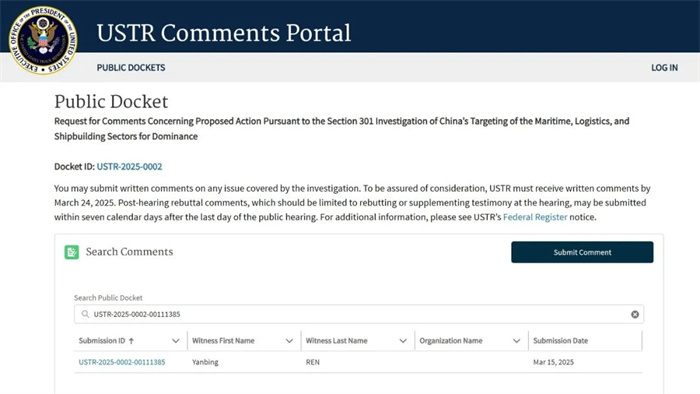
以上是任律师向USTR提交记录的截屏
附件:原文转载如下:
Comments on Proposed Action in Section 301 Investigation on China’s Targeting of the Maritime, Logistics, and Shipbuilding Sectors for Dominance
To: Office of the United States Trade Representative (USTR)
From: Ren Yanbing, a Maritime Lawyer
Date: 15 March, 2025
Re: USTR-2025-0002: Comments on Proposed Action in Section 301 Investigation of China’s Targeting of the Maritime, Logistics, and Shipbuilding Sectors for Dominance
______________________________________________________________________
On February 21, the Office of the United States Trade Representative (USTR) published the Proposed Action in Section 301 Investigation on China’s Targeting of the Maritime, Logistics, and Shipbuilding Sectors for Dominance (hereinafter referred to as the "Proposed Action") and invited the public to submit written comments on the proposed action. According to part III "Request for Public Comments" of the Proposed Action, the USTR, pursuant to Section 304(b) of the Trade Act, is seeking public opinions on the following matters:
(1)
The level of burden or restriction on U.S. commerce arising from China’s targeting of the Maritime, Logistics, and Shipbuilding Sectors for Dominance.
(2)
The appropriate trade to be covered by responsive actions, including the type and level.
(3)
Whether the fees or restrictions on services are appropriate, including the type of services to be subject to fees or restrictions, the level of fees or restrictions, and the structure of any fees, restrictions, or reimbursement of fees on services.
(4)
Whether a proposed action would be practicable or effective to obtain the elimination of China’s acts, policies, and practices.
The following comments address these four points. Specifically, the comment on Point (1) is that
"The decline of the U.S. shipbuilding is unrelated to the development of China's shipbuilding." The comments on Points (2) and (3) state that
"Imposing additional port fees and freight restrictions on Chinese-built vessels and their associated maritime transport operators is reckless and foolish and should not be implemented." The comment on Point (4) is that
"Imposing additional port fees and freight restrictions on Chinese-built vessels and their associated maritime transport operators will not impede the development of China's shipbuilding."
I. The Decline of the U.S. Shipbuilding Is Unrelated to the Development of China's Shipbuilding
Whether a country's shipbuilding industry can gain a competitive edge in the global market depends on its ability to systematically, fully, and sustainably cultivate and mobilize shipbuilding industry factors compared to another country, and whether it can provide more competitive vessels to global vessel consumers. If it can, the country's shipbuilding will make progress and take the lead in the global market competition; otherwise, it will decline and fall behind.
Between 1960 and 1980, the U.S. shipbuilding's share in the global market dropped from over 50% to below 5%, while Japan's shipbuilding's share rose to over 50% during the same period. From 1980 to 2000, the U.S. shipbuilding's share further decreased to below 2%, while South Korea's shipbuilding surpassed Japan's, and the combined share of South Korea and Japan exceeded 70%. This shows that the decline of the U.S. shipbuilding occurred during its competition with Japan and South Korea, and it has remained stagnant ever since.
The decline of the U.S. shipbuilding is due to its inability to systematically, fully, and sustainably cultivate and mobilize shipbuilding industry factors through acts, policies, and practices, and its inability to provide more competitive vessels to global vessel consumers. In contrast, Japan and South Korea's shipbuilding took the lead in global market competition during this period, which is reflected in their more systematic and full cultivation and mobilization of shipbuilding industry factors and their ability to provide more competitive vessels to global consumers.
Before 1990, China's shipbuilding accounted for about 2% of the global market, which was roughly equivalent to the U.S. shipbuilding's share at that time. Since then, China's shipbuilding has gradually made progress by adopting more systematic, full, and sustainable acts, policies, and practices, and by providing more competitive vessels to global consumers. It has taken the lead over South Korea and Japan's shipbuilding since 2010.
Moreover, when China's shipbuilding began to develop after 1990, the U.S. shipbuilding had already severely declined. Therefore, China's shipbuilding could not have burdened or restricted the U.S. shipbuilding. To be more precise, the decline of the U.S. shipbuilding is unrelated to the development of China's shipbuilding. Instead, it is related to the U.S. industry's own inability to cultivate and mobilize shipbuilding factors through more systematic, full, and sustainable acts, policies, and practices, and to provide more competitive vessels to global consumers. It is also related to the global market competition at that period between Japan and South Korea in the aforementioned aspects.
II. Imposing Additional Port Fees and Freight Restrictions on Chinese-Built Vessels and Their Associated Maritime Transport Operators Is Reckless and Foolish and Should Not Be Implemented
The international trade and shipping supply chain is a complex system, and any disturbance to one node will trigger complex systemic changes that cannot be managed through reckless actions.
Imposing additional port fees and freight restrictions on Chinese-built vessels and their associated maritime transport operators will disrupt the international trade and shipping supply chain in the short term. Market players in international trade and shipping will try to adjust their business strategies as much as possible to avoid incurring additional port fees in U.S. ports or U.S. freight restrictions, thus rendering these actions ineffective.
For global market players who cannot avoid U.S. port fees or freight restrictions by adjusting their business strategies, they will pass on the increased costs or inflation to U.S. commercial entities and consumers. The higher the fees or the stricter the restrictions, the greater the damage to the U.S. itself.
For global market players who cannot avoid U.S. port fees and freight restrictions and cannot pass on the costs, they will leave the U.S. market and develop markets outside the U.S. when it is not profitable. Such changes in supply and demand will further push up prices and inflation in the U.S. market, making the U.S. market a vortex of uncertainty.
Therefore, imposing additional port fees and freight restrictions on Chinese-built vessels and their associated maritime transport operators is a disturbance to the international trade and shipping supply chain, not a maintenance of stable order; it is a bullying and coercion of global (including U.S.) trade and shipping market players and consumers, not a maintenance of free trade; it is turning the U.S. market into a jungle full of thorns, not a maintenance of an open market.
III. Imposing Additional Port Fees and Freight Restrictions on Chinese-Built Vessels and Their Associated Global Maritime Operators Will Not Impede the Development of China's Shipbuilding Industry
Imposing additional port fees and freight restrictions on Chinese-built vessels and their associated maritime transport operators will lead to further intensified and disordered competition in the global shipbuilding market.
Under such circumstances, for China's shipbuilding to survive and develop in the global market, it will, on the one hand, adopt more systematic, full, and sustainable shipbuilding industry acts, policies, and practices to strive for progress and leadership in intensified and disordered competition and to provide more competitive vessels to global vessel consumers. On the other hand, China will also adopt more systematic, full, and sustainable industries acts, policies, and practices in terms of counter-sanctions and counter-containment, to create a more free, equal, and fair order in the global shipbuilding market. This will further stimulate the more robust development of China's shipbuilding.
The proposed action is an attempt to hinder global vessel consumers from obtaining more competitive vessels and to obstruct the systematic, full, and sustainable cultivation and mobilization of shipbuilding industry factors in the global market. It is an abuse of the U.S. Trade Act and lacks legitimacy. It is wrong and bad, that goes against the tide of history.
Sincerely,
REN Yanbing, a maritime lawyer